ROLE
Interaction Design & Creative Development
TIME
Nov 2026
FORMAT
Interactive 3D archive
TYPE
Personal project

OVERVIEW

My interaction design journey began with in-car experiences. Over six years, I designed interfaces, HMI experiences, and concepts for different automotive brands. I built a virtual showroom to archive that work, where visitors can choose a vehicle and explore the work in context.

LAUNCH FREYA'S GARAGE

Interaction Design

01

Collection

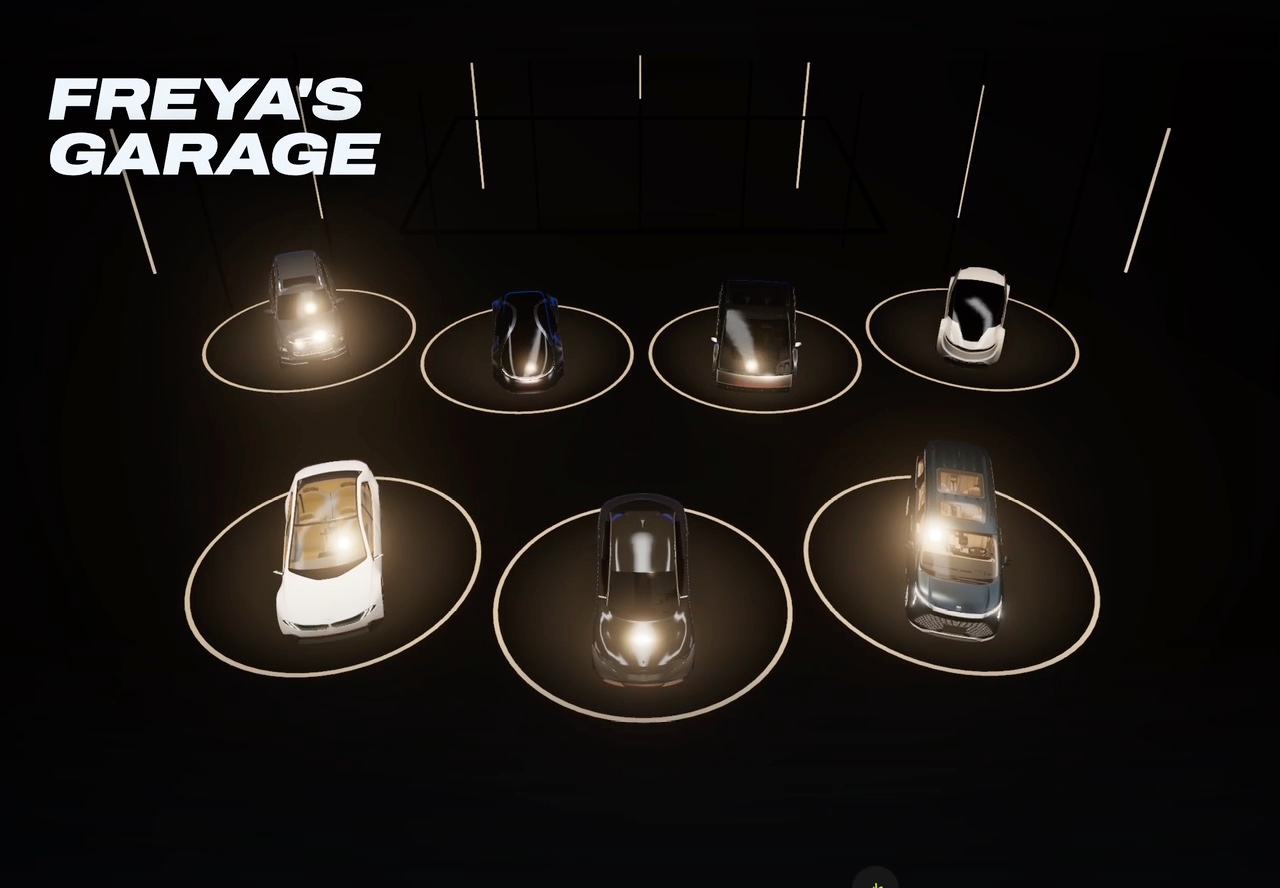
The Garage opens with seven vehicles arranged in a shared showroom, with three featured projects in the foreground. This layout gives visitors an overview of my past automotive work while highlighting selected projects.

Hovering reveals each vehicle's identity, and selecting a car moves the experience into a dedicated inspection view.

02

Inspect

The inspection view brings one vehicle into focus, with a dedicated platform, camera controls, and project information.

Visitors can rotate and zoom into the model, or switch between vehicles without returning to the collection. I wanted to make it easy to move between browsing the archive and examining an individual project.

03

Interior & Project Details

Automotive HMI is designed for a specific physical environment, and that context is often lost when presenting interface screenshots alone.

By placing my HMI designs alongside the vehicle's 3D interior, visitors can see where the interfaces belong, how they relate to the cabin, and why certain design decisions, such as unusual display shapes, were made.

Technical Implementation

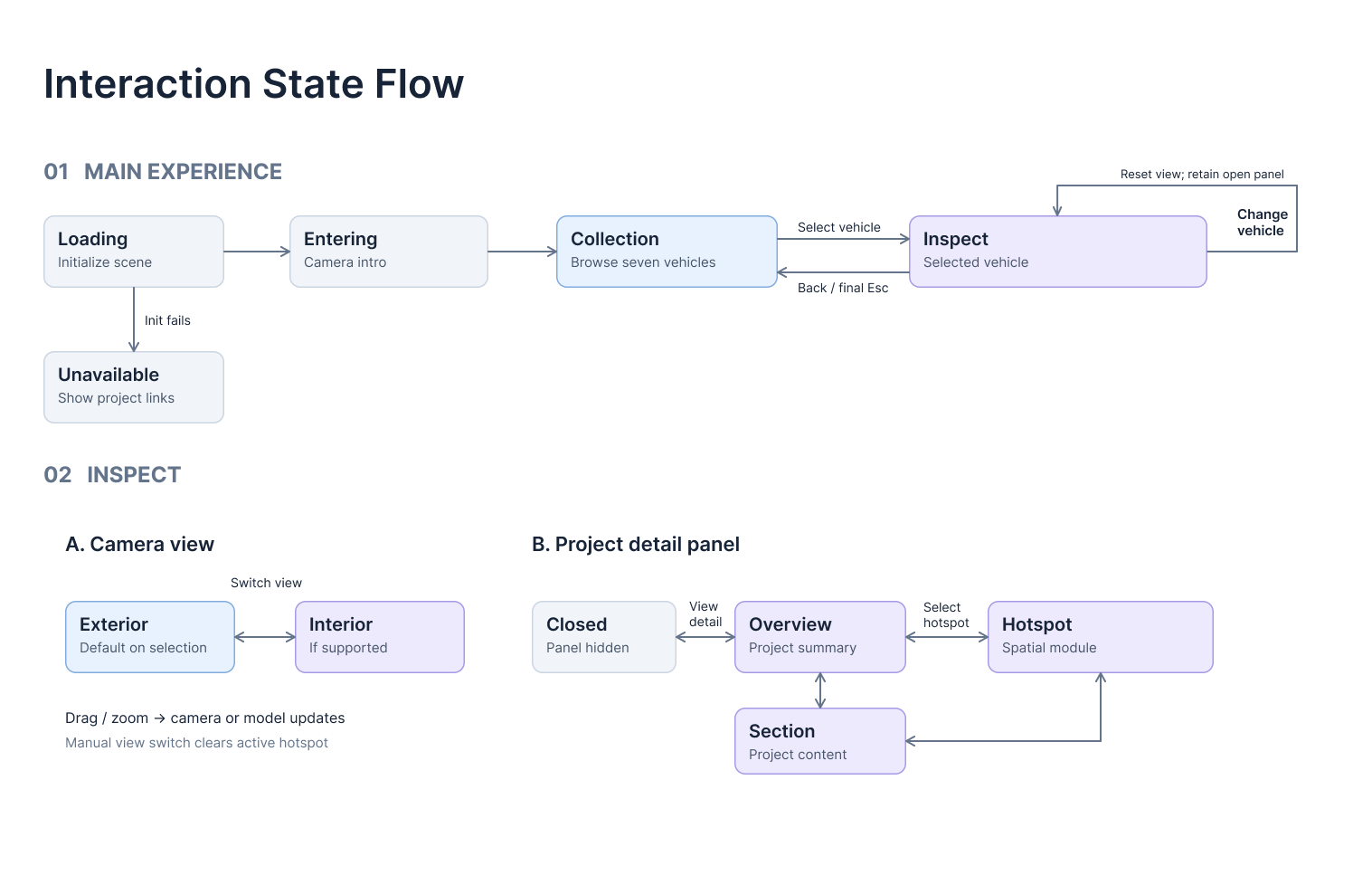
Interaction State Flow. The Garage progresses from Loading to Entering to Collection, with a fallback to project links if loading fails. Selecting a vehicle opens Inspect, where visitors can switch camera views and move between the project overview, sections, and hotspots.

Three.js: 3D Scene & Interaction

The showroom loads seven third-party GLB vehicle models (credited below), simplified and compressed for the web with a small Python pipeline. Raycasting identifies which vehicle the visitor is pointing at, while camera and model transitions move the selected car into the inspection area.

React: Interface & Interaction States

React manages vehicle selection, active views, and project panels. A shared project data file connects each vehicle to its models, case studies, films, and interactive points.

Keeping the project content separate from the scene logic makes the collection easier to maintain and extend.

AI-Assisted Development

I built this project with the support of Claude Code and Codex. I directed the visual design, navigation, vehicle selection, and camera behaviors, then tested and refined the resulting prototypes in the browser.

Design Evolution

01 From Racetrack to Interactive Portfolio

The initial concept was a playable racing experience where visitors could select different vehicles and drive them on a racetrack. While this approach explored the playful potential of an interactive portfolio, I ultimately decided to shift the focus from driving mechanics to the automotive design work itself.

02 Exploring the Interactive Garage

The second iteration shifted toward a dedicated garage environment. I introduced 3D vehicle models and an inspection mode, allowing visitors to explore individual vehicles and their associated design projects. This iteration established the core interaction framework of the experience.

03 Refining the Automotive Experience

Inspired by the visual language of automotive video games, the final iteration reimagined the environment, lighting, and UI. The goal was to create a cohesive, immersive showroom experience while balancing game-inspired aesthetics with the clarity and accessibility of a design portfolio.

Reflection

For years, I struggled to present my automotive design work in a conventional web portfolio. Unlike standalone apps or websites, in-car interfaces are deeply tied to their physical and spatial context. When reduced to isolated screenshots, much of the original design intention is lost.

Building Freya's Garage allowed me to rethink not only how I present my work, but also how people experience and understand design through spatial interaction. Rather than simply documenting past projects, I wanted the portfolio itself to become an interactive experience worth exploring.

What began as a personal archive gradually evolved into an exploration of spatial interfaces, game-inspired interaction, and creative coding. In many ways, this project brings together my professional background in automotive interaction design and my current interests in HCI research and interactive experiences.

It is both a reflection on where I started and an expression of the kind of designer and researcher I am becoming.

LAUNCH FREYA'S GARAGE

3D Model Credits & Licensing

The vehicles displayed in Freya's Garage use third-party 3D models sourced from Sketchfab. These models serve as visual representations of my past automotive design projects and may not depict the exact vehicles involved. They are display stand-ins: their interiors and cabin layouts do not reflect the actual spatial configuration of the projects.

I did not create the original vehicle models. Where permitted, models were modified and optimized for real-time web rendering. All original model creators are credited below, along with links to their work and applicable licenses.

Automotive brand names and vehicle designs remain the property of their respective owners. Freya's Garage is an independent portfolio project and is not affiliated with or endorsed by these brands.

Web rendering changes. Geometry was flattened and merged by material, vertex data was quantized, and each model was exported as a single GLB. Where needed, hidden parts were removed, meshes simplified, and textures resized.

Keep exploring.